
Recab AB · Industrial Electronics
CASE-003
Recab: Website Rebuild
A full WordPress rebuild for an industrial electronics company. Structured content architecture, dynamic mega menu, custom URL system and SearchWP across 450+ products and datasheets. Products now rank top 10 on Google for their exact search terms without the company name in the query.
| Client | Recab AB |
| Year | 2025 |
| Service | WordPress Website |
| client revenue | 158M SEK |
| products structured | 450+ |
| Google rankings for exact product search terms | Top 1-3 |
| Status | Complete |
The client
Recab is an industrial electronics distributor based in Stockholm, Sweden. With 158M SEK in revenue and membership in a 196-company group Addtech, Recab supplies technical components to some of the most demanding industries in the Nordics: defense, maritime, machine automation and critical infrastructure. Their product catalogue spans 450+ products across categories like industrial embedded computers, industrial data communication, single board computers and panel PCs, sourced from specialist manufacturers worldwide.
For a company whose buyers are engineers and procurement managers who know exactly what part number they need, the website is not a brochure. It is a technical tool. It needs to work.
The problem
The existing website was built on WPBakery by an agency that no longer existed as a working relationship. When the rebuild began, there was no handover documentation. No plugin credentials. No explanation of what did what or where anything lived. Some plugins could not even be updated because the license details had never been shared. The site was inherited as a black box.
Inside that black box, the structural problems ran deep.
Everything lived in Pages. Products, articles, employee profiles, supplier information, job listings: all stored as standard WordPress pages with two fields each. A title and a text box. No Custom Post Types. No structured fields. No separation between content types.
Product titles were the only source of information. Without dedicated fields for part numbers, manufacturers, specifications or categories, everything had to be written into the title. But even that system had broken down. Products were named things like "V1000" or "COM Express" , not the part number, not the manufacturer, not enough information for anyone to know what they were looking at. Was it a product? A category? A page? There was no way to tell.
URLs were numeric. Products had slugs generated automatically by WordPress, like recab.com/product/48928420. No category context. No part number. No meaning. Search engines and visitors had nothing to work with.
The search blended everything. The default WordPress search returned pages, products, articles and everything else in a single undifferentiated list. There was no way to filter by content type, no way to search specifically for products, and no connection to the PDF datasheets attached to products. A buyer searching for a specific component by part number was unlikely to find it.
The navigation was a standard dropdown that nobody maintained. The previous agency left a dropdown menu that listed categories. But because the site was so difficult to understand and change, the menu had not been kept up to date. Adding a new category meant manually editing the menu, which required understanding a build with no documentation. The result was navigation that reflected the site as it was built, not the site as it existed.
500+ pages with no way to manage them. Because all content types lived together in Pages, the team had no way to identify what was current and what was outdated. Discontinued products, former partners, old announcements: all mixed together with live content. Nobody knew where to start removing things because removing the wrong thing could break something, and there was no map.
The site was not being updated. The combination of no documentation, no structured system and no safe way to make changes meant the Recab team had largely stopped trying. Ironically, the lack of updates had protected some search rankings in the short term. But a catalogue business that cannot add new products, publish partner news or update its own information is not running a website. It is running a static page with a maintenance problem growing underneath it.
The solution
The rebuild took six months, built alone, with updates to the managing director every two weeks. The goal was not to redesign a website. It was to build a content system that a technical company with a deep catalogue could actually run.
A structured content architecture
Seven Custom Post Types were built using JetEngine, each with its own purpose, its own fields and its own display templates:
- Products , with structured meta fields for part number, short description, long description, features, specifications, standards and certifications, application areas and downloadable datasheets
- Recab News , company announcements and updates
- Partner News , manufacturer and supplier updates, clearly separated from Recab's own content
- Knowledge , technical articles, white papers and guides
- Employees , team members with role and department
- Career , job listings with individual post templates
- Suppliers , manufacturer and partner entries used in navigation and the partners page
Pages became strictly for static content: the homepage, industry pages, the company section, contact and legal. Nothing dynamic lives in Pages.
When a Recab team member adds a product today, they fill in a structured form: part number, manufacturer, short description, long description, features, specifications, certifications, application area. Every field has a label and a purpose. The product appears on the site with a consistent layout, correct URL and correct breadcrumb without anyone touching design or code.
Taxonomies that power navigation, filtering and search
A full taxonomy system organises products across multiple dimensions simultaneously. The product category taxonomy spans three strict hierarchy levels:
- Parent (e.g. Industrial Data Communication, Industrial Embedded Computers)
- Child (e.g. Switches, Edge AI and Machine Vision)
- Grandchild (e.g. Managed Switches, Network Switches)
Products are assigned to exactly one category at the most specific level. The hierarchy handles the rest: a product in Managed Switches is automatically part of Switches and Industrial Data Communication through the taxonomy tree. Additional taxonomies cover industry tags, manufacturer tags, product features, form factors, standards and certifications, data rates and processor types.
The dynamic mega menu
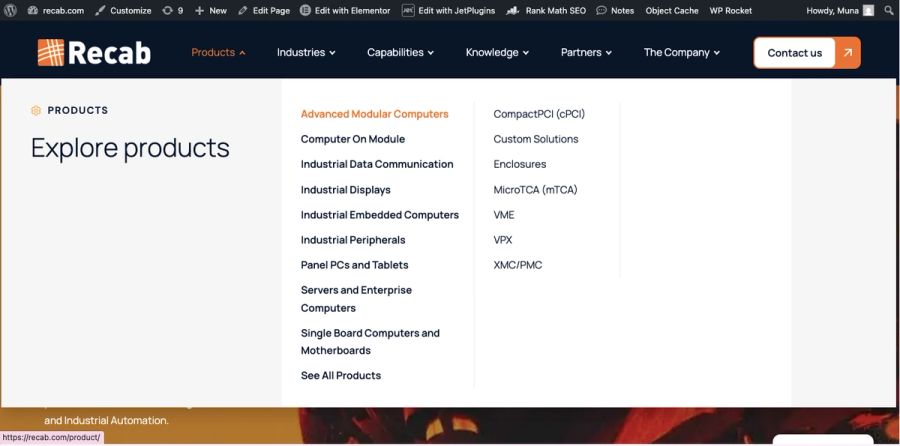
The product navigation is built from the taxonomy, not maintained manually. A custom PHP function and JavaScript layer read the Product Categories hierarchy and generate the three-column mega menu in real time. Two rules keep it reliable: categories with zero products are hidden automatically, so visitors never land on an empty page. When a new category is created and products are assigned to it, the menu updates without anyone touching navigation settings.
The previous dropdown required manual maintenance and documentation nobody had. This one maintains itself.
URLs that mean something
Every product URL now reflects exactly where that product sits in the catalogue:
recab.com/product/computer-on-module/com-express/som-5871-amd-ryzen-v1000-com-express-type-6-module-by-advantech/
The full category path is in the URL. The part number is in the URL. The manufacturer is in the URL. Custom PHP handles permalink logic and breadcrumb generation, keeping the URL, the breadcrumb trail and the taxonomy hierarchy in sync. The same system was extended to Knowledge articles, Partner News and Career posts.
SEO built into every product
Every product follows the same formula across all 450+ entries:
- Title: Part number first, then full product name, then manufacturer
- Short description: Introduces the product by name and manufacturer, confirms the manufacturer is a Recab partner. Written in variation across products so search engines do not treat the catalogue as duplicate content
- Long description: More detailed, covering technical context, use cases and specific differentiating details
- Structured fields: Features, specifications, certifications and application areas appear as structured content on the page, not buried in a text block
After the rebuild, Recab products began ranking in the top 10 for their primary search terms: part number combined with manufacturer name, without Recab appearing in the query at all. The site is now updated with partner news at least three times per week. Regular, structured content updates compound the SEO benefit over time.
Search that finds what buyers are looking for
SearchWP replaces the default WordPress search. It indexes product titles, part numbers, both description fields, taxonomies and attached PDF datasheets. Results can be filtered by content type: products, news, articles. A buyer can search for a part number and find the product. They can search a keyword from a datasheet and find the document. They can filter results to show only products if that is all they need.
Performance, security and privacy
WP Rocket handles caching and file optimisation. ShortPixel compresses images automatically on upload. Wordfence provides firewall and malware protection. Complianz manages GDPR cookie consent, controlling when Google Tag Manager and analytics scripts are permitted to load. WP Activity Log records all admin actions across a multi-user team, providing the audit trail and accountability the previous build never had.
How products get added
The initial 450+ products were added using a Make automation: PDF datasheets uploaded to a Google Drive folder were scraped, field data was extracted into a Google Sheets document and imported via WP All Import. Product images were added manually. This handled the catalogue migration.
Six months later, a second project replaced the manual process with an AI-powered plugin built specifically for Recab. That story is in CASE-002.
The result
The Recab website is now a content system the team can use.
Products are added through structured forms with clearly labelled fields. News is published three or more times per week. The mega menu reflects the current catalogue without manual updates. Outdated content can be identified and removed by content type. The URL structure, breadcrumbs and search all work together.
Buyers find products by part number, manufacturer, category, certification and keywords from datasheets. Products rank in the top 10 on Google for their exact search terms. The site is live, actively maintained and the working relationship with Recab continues.
The previous agency left no documentation. This build has 154 pages of it.
The second project with Recab , an AI-powered product importer that reads PDF datasheets and structures product data automatically , is in [CASE-002.]
Key numbers
158M SEK
client revenue
450+
products structured
Top 1-3
Google rankings for exact product search terms
Complete
Status